This article is about the revolution we have started, the evolution we are looking after, and the future we are making today.
Every epoch, each society has its own bifurcation point — sometimes just a very specific time and place, sometimes spanning other decades — which redefines the life style, economical and societal fundamentals of one country, regions or even of the whole world. The XX century was surprisingly rich for such events. In 1920s one such event was the invention of conveyor and economy of mass production, in 1950s — it was nuclear energy and space technologies, in 1970s — microelectronics and biotechnology, and finally, on the edge of centuries — Internet, robotics and practical DNA constructing.
Each wave dramatically changed the world, but despite differences, they all have something in common. This is a driving factor — the growth of humanity, both physical (the search for the fresh energy sources) and intellectual (hunger for the knowledge about world out there and beyond), but first and foremost — each wave was impossible without the previous one, preparing the platsdarm for the next jump.
It’s unthinkable to understand DNA code without complex calculations, and those calculations are impossible without computers, hence the revolution in understanding of DNA code would not had started without invention of CPUs due to the very same reason as it’s impossible to build microprocessors using just screwdriver. So, even though all waves look different, they are actually parts of one giant game with unknown final goal hiding in the misty shadows of the future, the game with rules which are consonantly changing on each move.
The next wave I can define as appearing and global spreading of self-sufficient, sustainable and intelligent technologies. By sustainable I mean here the technologies which can provide further growth of current civilization after logical burning of all oil and coal we have on Earth (the latter is necessary in order for the next two biggest countries in the world, China and India, to reach US/Western Europe’s level of HDI and to become advanced economies). Also those technologies can help to jump over the so-called complexity barrier in solving progressively sophisticated problems (complexity barrier is the situation, when at some point the problems are becoming so complex, that people are not even able to understand or solve them without some tools and base level of knowledge; the classic example is skyscraper technology, aka engineering of super-high rise buildings, which are simply impossible without invention of cranes, strong materials and advanced knowledge of static mechanics — the skyscraper cannot be built by stacking one brick on the top of another one without end, this is a construction of completely different engineering level).
The growth without limits is not about transforming, exchanging one resource into another one (like tree into the book), it’s about using less resources to produce more, to achieve more, mocking the ecosystem on Earth, which managed to self-organize somehow to such degree that finally had allowed the descendants of eukaryotes from the ancient Ocean to read articles on Medium one billion years later)
We cannot fork another biological evolution on Earth, and cannot construct DNA from scratch, but it’s feasible to fork a technological evolution, to design machines and give them the unpredictability and stubbornness of life, without falling into mechanical imitation of Nature, to start a separate branch of development and forever change the natural flow of history.
There is one missing element of mosaic here, one can call it AI, or self-awareness, or independence, or something else. But whatever call it, it has to be the truly bifurcation point, with potential which can slowly unfold into infinity, with the promises higher than ever before.
Unfortunately, the only clear thing here it seems this hypothetical bifurcation point is not going to be a point, but the whole epoch spanning over decades, maybe hundreds of years. Why is it so? Because in reality any evolution still has to comply some fundamental laws, and taking into account that the road from the first microorganisms on Earth till relativity theory was 3.42 billion years (roughly), the artificial techno evolution, even accelerated trillions of times, will require significant amount of time. If to think about transistors as analogs of cells in real nature, modern hardware is still on the level of viruses (at best).
As for software, the most advanced types of artificial neural networks (DNN + CNN) are just nothing but optimization tools, which can find the sub-optimal or near-optimal solution to NP-hard problems (like Traveling Salesman Problem, Chess or Go), or generate the colorful pictures using hidden correlations in colors, styles and strokes in real paintings created by artists, or “write” the symphony using the same approach. But isn’t it just algorithm, the way to find correlations in data set or mold the solution into constraints rather than creating something original?
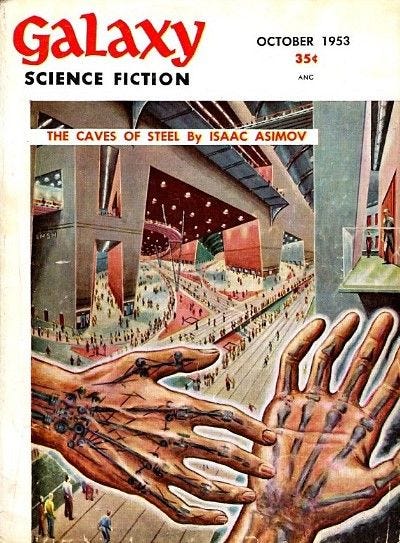
Isaac Asimov in his sci-fi books greatly speculated about XXI century, but it seems he looked into the mirror, rather than into the future. He thought of robots as almost identical copies of humans, like human-like dolls, with character and personality, just made of different material. But as we know now, extrapolations normally do not work.
The reality could look like another speculation about AI — hive mind, the awareness everywhere and nowhere, and this scenario tends to be more realistic.
Imagine yourself over-increasing level of automation of everything which can only be automated, from automatic mines where robots and TBMs extract basic resources, till automated production lines and conveyors at factories producing millions and millions of item types, from pens and paper till cars and houses.
Imagine yourself the automatic factories which produce other components which factories are built of, closing in such manner the production cycle.
And finally, imagine yourself the control of all of this in the form of directives, commands, heuristics and strategies, so complex and interconnected, that in some moment it will become non-essential, who is actually the originator of some command — the Homo Sapience or some automated process? Of course, we are not going to outsource important decisions to machines, but if in the beginning this command would be like “turn off AC if there is too cold tomorrow in 8 AM”, but in 100 years from now it will (no doubts) become “think about how to improve the harvest of apples next year”, and this initiative will appear in the mind of machine.
AI will become the smart environment, where the consciousness is so elusive as it is in real brain. And what has started from the dreams about smart home will become a smarter future.