
This article is to describe my journey to achieve the mastery in English. It was an extremely non-linear process, and this is one of the pieces which helped me to reach the goal.
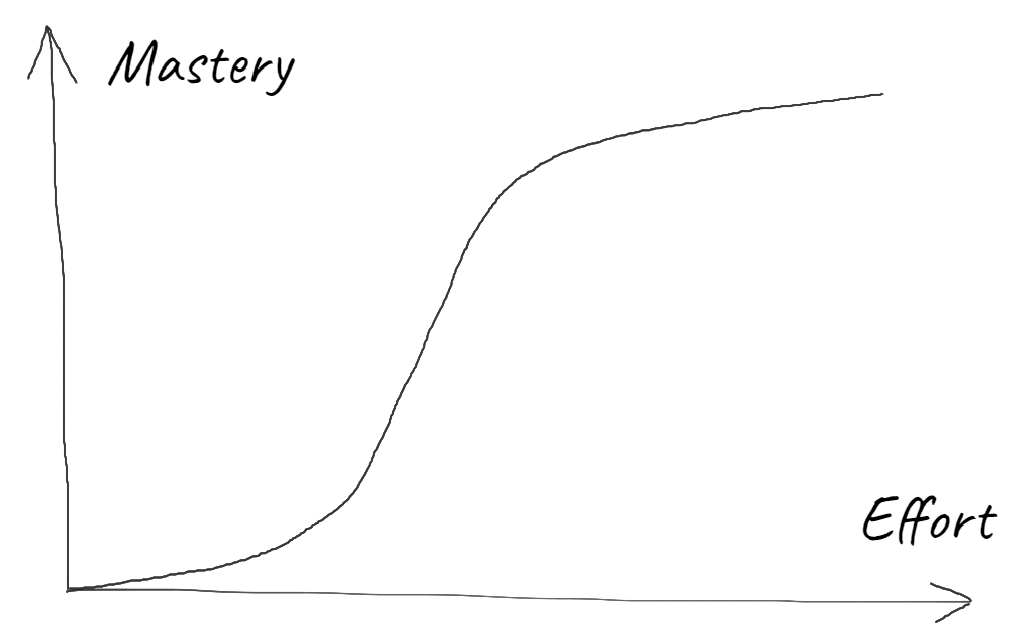
Studying foreign language is a meandrous, lengthy process, and the learning curve normally has a sigmoid shape. Usually it’s quite flat in the beginning, because you need to learn the basics, the building blocks and rules — without them you will speak a completely different language! This is followed by the phase of exponential expansion of the associative cloud of notions, concepts, idioms and of course words. After achieving an advanced level in English, the biggest obstacle to further progress is a problem of so-called creative writing, which requires not just good language skills, but also creativity, the ability to generate good ideas and put them to paper, which sometimes is difficult even if English is your native tongue.
After receiving my IELTS Academic C1 certificate, I started asking myself a question, why does the prose of my favorite writers — Robert Jordan and J.D. Salinger — look so good and sound almost like a song, while everything I am writing at best looks like the business letters from the bank — so bleak, clumsy and boring? In most cases the words were the same, but they missed their power, the magical ingredient which alchemically transforms “just words” into powerful, inspirational stories which are interesting to read.
One day, posting a picture on Instagram, I decided to add more text to the caption — more than usual hashtags and title (since IG allows you to attach up to 2200 characters to each picture anyway). The reason was simple — that text was supposed to be a memo, explaining why I took that picture and decided to store it at all. After that I thought: why not do this on a persistent basis? It could be fun and useful. In other words, I was about utilizing my IG account as an illustrated blog, rather than a gallery, to use it as a diary with glossy postcards, as a memory book keeping reminiscences about bright events, interesting artifacts, things which I liked, people that impressed me, achievements I was proud of. I have a photo archive close to 100GB of raw data, but starting forgetting when and why I did all these photos.
Writing a good description for the picture/photo definitely requires some creative skills, even if you are just describing what is in the picture. The same picture can trigger a completely different sequence of thoughts in different people, so the description of what it means for you could come in handy. Describing your thoughts, your associations, what you are feeling — isn’t it exactly the prerequisite for creative writing? True: you have a topic — a picture, a task — to write 2200 characters of text, and the only thing you have to do is to start that journey, and then just go with a word flow.
The text you are writing defines the title, and as a result thinking about what to write helps to give your post a good title, defining in that way much clearer what you actually want to remember when posting a picture. In addition, such types of exercises help to develop other relevant skills, such as observation, to expand your figurative language (metaphors, similes, etc.) And last but not least — this is normally a habitual, repetitive activity, and in learning foreign language consistency and persistence is the key to success and infinite growth.
Of course, from the first glance using Instagram as a diary looks a bit absurd: who actually reads all these captions these days? People scroll the pictures and watch the reels! But from the other side, why should I care if creating a gallery was not the primary goal in the first place? Having these thoughts in my mind, I decided to try this experiment. Here we go!
After around 100 posts I decided to estimate the volume of words I have written so far. In practicing English the rule “quality over quantity” does not necessarily work — during learning you have to train your brain to remember the spelling of all those words (unless you have the eidetic memory), so repetition does help a lot. And you don’t have to write a perfect post — this is just practice!
Of course, the size of posts was different (and deviation was quite big), but on average I wrote 75 words, including hashtags and title, which gives us 75 X 100 = 7500 words.
There are different systems for story classification by the word count, but here is a reasonable breakdown which I found in one article:
Short Short Story (1,000 — 4,000)
Long Short Story (4,000 — 7,500)
Novelette (7,500 — 17,500 )
Novella (17,500 — 40,000)
Novel (40,000 and up)
Which means that I have effectively written a short story already, in addition to other ways to study English! Since those writings are not really a kind of boring text of the letter from the bank, and they reflect what I was impressed by and interested in, this is almost a perfect implementation of creative writing setup, and I can work on polishing my English in a fun way. A simple projection says that after the counter on my IG has reached 534 posts, I will have a graphic novel distributed in Space-Time, a secret art project, a Bouts-Rimés poem made up from the sequence of pictures instead of a list of rhymed words, and after that I can officially call myself a writer. How cool is that?
To summarize, in order to reach a really good level of English (or any other language), the most important thing is to use every opportunity to learn, and one can find these opportunities literally everywhere, the only thing you have to do is just to see them. Even such peculiar habits as writing descriptions to the pictures definitely helped me increase my vocabulary and develop the skills to write promptly something meaningful (or not so). Of course, it was not by any means the primary way for me to learn English — just a tiny part, a drop in an ocean, but as Ovid said “Dripping water hollows out stone, not through force but through persistence”
My IG: https://www.instagram.com/akaliutau/