
Last week, on June 18th, the UKIVA’s machine vision conference (MVC) event and tech show kicked off in Coventry. In 2024 it was co-located with another event — Automation UK. This is quite an interesting event, a wonderland of technology for everyone who is interested in robotics, machine vision and AI technologies. In my article I’m going to describe my impressions, new tech I saw and key trends I’ve had the pleasure to learn about. It was interesting, insightful and inspirational.
I usually do not have time to attend conferences; however, I find it beneficial to occasionally participate in meetups and tech events, particularly those within a commutable distance from London. For instance, in April 2024, I attended a meeting with leaders from Aerospike during their European tour, which focused on showcasing and promoting Real-Time Data technologies — though that’s a story for another time.
Coventry definitely is not a place close to London, nevertheless I decided to visit MVC because of two reasons.
First, the conference and its dedicated exhibition aimed to provide insights into “the very best of industrial vision and imaging,” and I was curious about what is considered the frontier technologies in this field. Second, I wanted to experience these technologies firsthand, to understand how they operate in the real world as opposed to just viewing pictures on a company’s website or videos on YouTube (which by the way not always possible because companies rarely publish too technical demos). This interest was both professional and personal, as my future research will involve AI, automation, and related fields.
There was also one, less important reason — I wanted to know the format of UK conferences, so I expected an interesting experience.
The conference was held at the Coventry Building Society Arena, situated on the outskirts of the city. There is a direct train from London to Birmingham that stops at Coventry, making it easily accessible. The only potential challenge was the last hop of the journey, as the distance between the train station and the Building Society Arena is 5.5 km. It could be quite a long walk if you are a fan of walking, so it’s better to take a local bus.
The day was windy and sunny, with an overcast afternoon, but this was not important at all, since the exhibition was entirely indoors. I arrived at 9 AM and received my badge. The first hour served as a warm-up and an opportunity to look around; all seminars commenced at 10 AM.
When it comes to conferences, even attending them as a visitor or guest, it’s essential to plan ahead of time and decide which sessions to attend and what exactly you wish to learn during the available hours. This is crucial due to the sheer number of stands (for example this time it was 46 of them in total), and the inevitable overlap of seminars within the conference’s program: there were 33 seminars across three theaters. Even dedicating a mere 10 minutes per stand, exploring the entire exhibition would take over 7 hours.
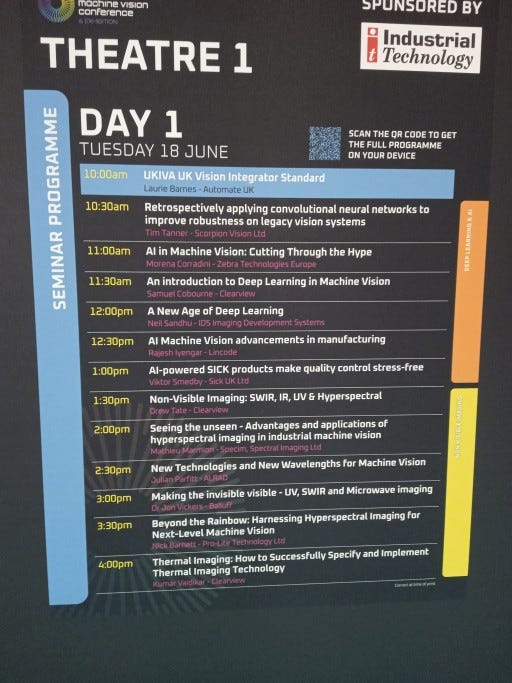
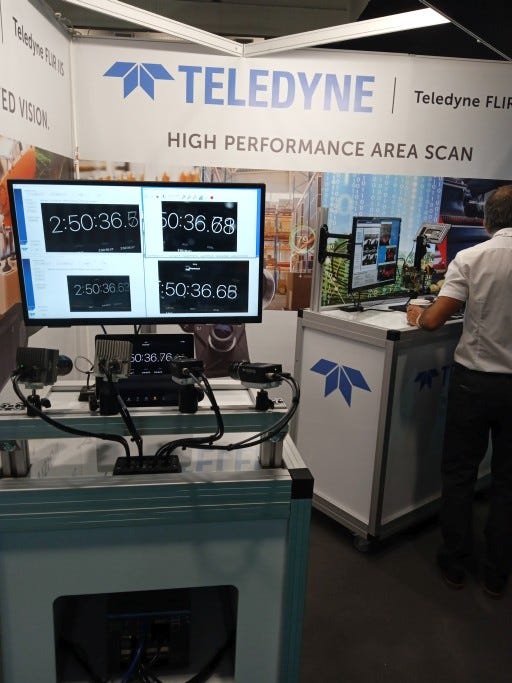
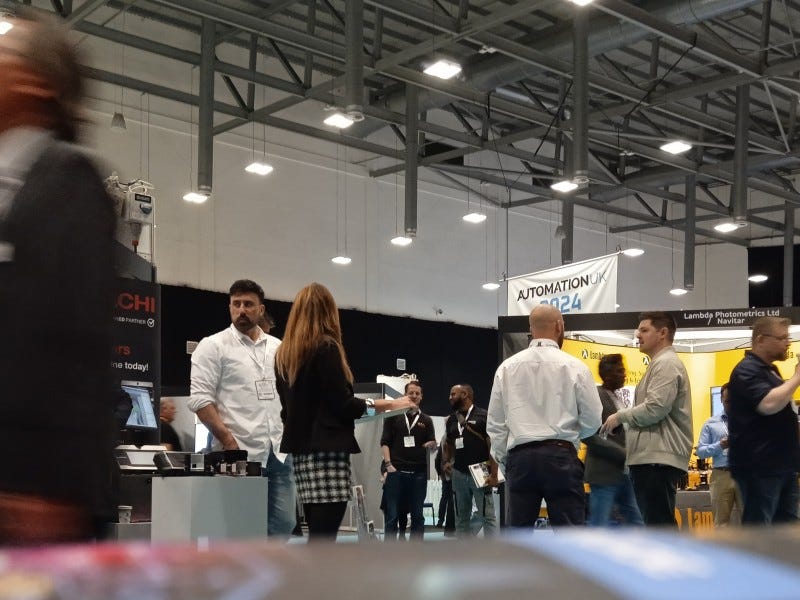
My first stop at the conference was to visit several companies I had pre-selected the day before, focusing on specific technologies (I was primarily interested in AI-related tech and 3D scanners), so I took a quick look at their stands first. The companies were LMI Technologies and Lincode, and a couple of others. Overall, the event was a representative exhibition of machine vision technologies, emphasizing both components and complete solutions. Approximately 20–30% of all stands featured new hardware such as cameras, controllers, and specialized lighting equipment. This event struck me more as a technology fair with a sales aspect, rather than a showcase of new technologies.
LMI Technologies is a Canadian company specializing in 3D scanning and inspection. I was curious about their 3D cameras and “Embedded AI” technologies. Lincode on the other hand has not much to do with machine vision at all, this is more a (potentially successful) use-case of applied AI to solve the generic QA and visual inspection problem in various industries. Essentially, it’s a glimpse into that bright, fully automated future where factories operate without human intervention — welcome to Industry 4.0 in full spark! Lincode is among many US-based AI startups that have emerged in the Bay Area over the past five years, appearing and growing as mushrooms after the rain.
As many companies showcased vision hardware, it was unsurprising to find the stands crowded with cameras, sensors, and the occasional robotic arm for solution demonstrations.
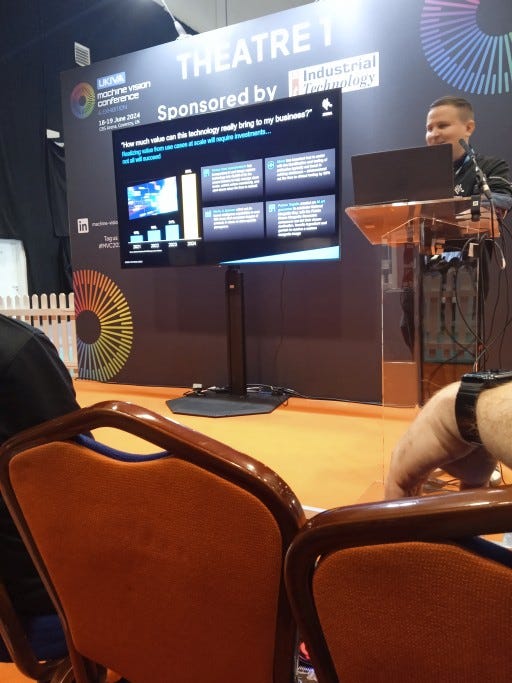
It was fun to watch presentations and listen to presenters. The conference spanned two days, with reversed order of seminars on each, so in theory one could catch the missed sessions on the second day, but there were a lot of overlaps anyway. I’ve picked up AI in Machine Vision: Cutting Through the Hype, A New Age of Deep Learning, AI Machine Vision advancements in manufacturing, Elevating AI with GMSL Cameras and some others. The presentations were concise, lasting no more than 15 minutes each. I appreciated the clarity and brevity, because one could easily get the additional insights at appropriate stands anyway. It’s funny how much actually one can say in 10 mins, if to proper structure your speech!
The MVC ’24 took place in Coventry, as well as it was in previous year. I expected Coventry to be a sleepy boring suburb town (partially it was), but the town center was surprisingly rich for historical buildings, artifacts and places to visit. In fact, the whole city center was a one giant cultural exposition with typical for the UK coexistence of millennia-old buildings with 21st-century architecture — a visual delight to explore before departure. Coventry Cathedral was one of the obvious sites worth visiting, but there were plenty of equally interesting small places which are normally not even mentioned in guides or somehow poorly visible or obscured on Google Maps.
To summarize everything said above in one sentence, one might say in the following boring way: smart devices are becoming progressively more intelligent. “Edge AI” and “Deep Learning on Device” have become increasingly popular over the last 5–10 years, meaning ML revolution started spreading and invading the most fundamental levels of technology, down to the hardware itself. In fact, it started more than 20 years ago, and has exponentially accelerated in the 20s. It is evident that the technologies we now consider innovative and advanced, will soon be as commonplace and unremarkable as the face-tracking cameras on our smartphones. Plus manual labor in factories (any factories to be exact, in any industry) will become a thing of the past very soon.
Perhaps the most valuable lessons I learned that day were the clear demonstrations of how to present new technology to an audience and how to effectively advertise products through live demos at exhibition stands. There’s a saying that it’s better to see something once than to read about it a hundred times, and I grabbed the opportunity for that and don’t regret it.
In essence, the technology conference is not just a “knowledge-building moment” to learn something new, to catch up with latest trends and so on. It is a masterclass in communication, marketing, and the art of engagement. The technological progress, the future of technology is not just the creation of something and in pure innovation, but also in presentation and adoption of inventions. This worked for me, and hopefully the future will give me more learning opportunities like that.
[1] https://www.automation-uk.co.uk- Automation UK (official website)
[2] https://machinevisionconference.co.uk — MVC conference (official website)
[3]https://www.instagram.com/akaliutau/ — extra photos from event can be found on my IG